

How to improve clay soil organically is one of the most searched gardening questions in Britain and the honest answer is that it takes longer than most blogs will admit. However, it works. The results are real, lasting and far better than anything a bag of sharp sand can deliver.
Why Clay Soil Is Not the Problem You Think It Is
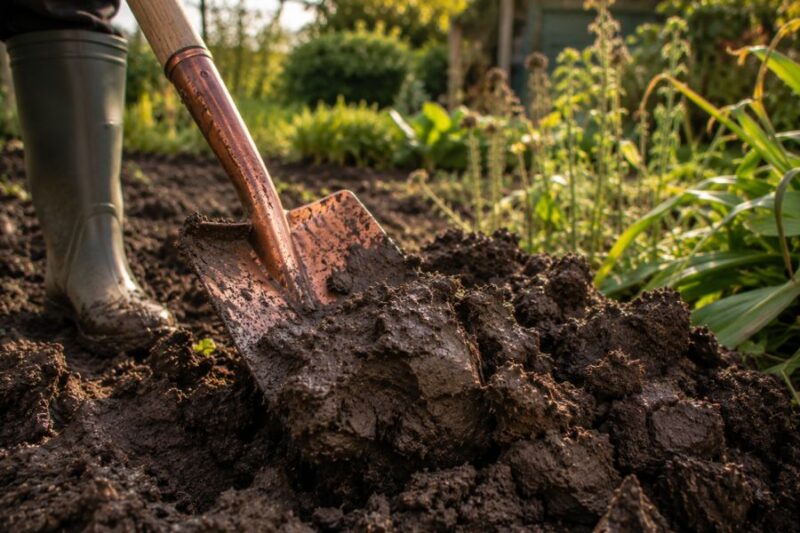
Clay soil has an unfair reputation. Gardeners describe it as sticky, waterlogged and impossible to work. Yet clay is actually one of the most nutrient-rich soil types in the UK. The particles are so fine that they hold minerals tightly and retain moisture over summer dry spells far better than sandy or silty soils.
The problem is structural, not chemical. Clay particles compact densely together, leaving little room for air, water movement or root penetration. Earthworms struggle to move through it. Beneficial microbes are starved of oxygen. The soil is nutritious in theory but largely inaccessible in practice because the structure prevents roots and biology from doing their job.
This distinction matters enormously. You are not trying to replace your soil. You are trying to open it up.
How Clay Soil Behaves Through the Seasons
Clay expands when wet and contracts as it dries, creating the familiar surface cracks in a dry July. This freeze-thaw and wet-dry cycling is actually your ally in the long term, because it naturally fractures compacted layers over time. The challenge is that heavy autumn rain, arriving before you have improved the structure, can set clay solid again, which is why timing your interventions counts.
The Organic Approach: Build Structure Rather Than Fight It
The conventional advice, dig it over, add grit, work it hard, often makes things worse. Adding fine sand to clay soil is one of the most persistent gardening myths in circulation. The result is not improved drainage. The result is something closer to concrete. Sand particles and clay particles bond under pressure to create a dense, impermeable layer that is harder to work than the original soil.
The organic approach works differently. Instead of fighting clay’s physical properties, you introduce materials and biology that gradually alter the soil’s architecture from within. This takes more than one season. Set your expectations accordingly and you will not be disappointed.
Biochar: Creating Permanent Air Pockets in Clay
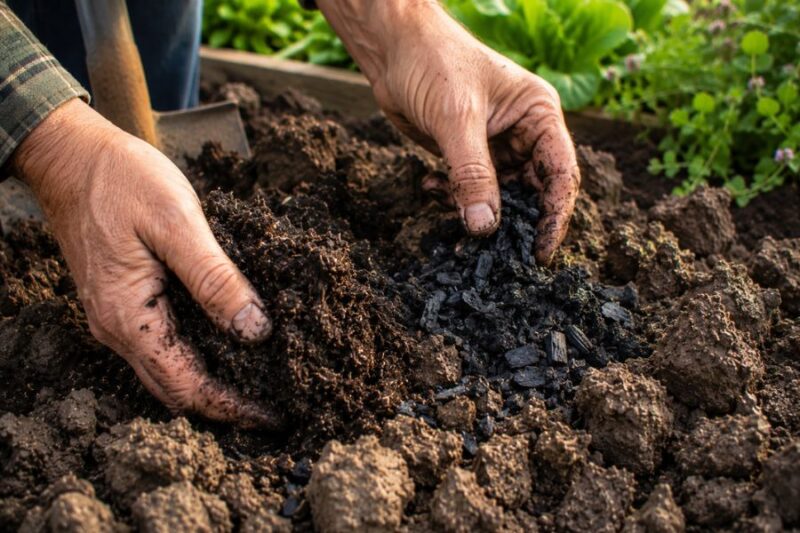
Biochar is the single most effective long-term amendment for clay soil and it is permanently undervalued in mainstream gardening advice. When incorporated into heavy clay, biochar’s porous structure creates stable micro-cavities that clay particles cannot fill and compact around. These pockets improve aeration, support drainage and critically, provide habitat for the microbial communities that break down organic matter and release nutrients to plant roots.
Unlike compost, which will eventually decompose and needs replenishing, biochar persists in soil for centuries. Research published by the UK Biochar Research Centre at the University of Edinburgh confirms that biochar improves soil water retention while simultaneously improving drainage in compacted soils, an apparent paradox that makes complete sense once you understand the micro-architecture it creates. You are not choosing between drainage and moisture retention. Biochar delivers both.
If you want to understand the science before you buy, the Biochar 101 guide covers everything you need to know about how it works and how to apply it.
Wormcast and Compost: Introducing Biology That Does the Work
Biology is the engine of soil improvement. Earthworm populations in healthy soil physically break up compacted layers as they move, digest organic matter and excrete nutrient-dense castings. In clay soil, their populations are often suppressed because the structure is too dense to move through. Introducing biohumus wormcompost directly to the soil jump-starts this biological activity by seeding the soil with microbial populations that begin conditioning it immediately.
Wormcast also contains plant-available nutrients, growth hormones and beneficial bacteria at concentrations that standard compost cannot match. For a deeper look at what wormcast actually does and why it is different to ordinary compost, the wormcast 101 guide is worth reading before you plan your application.
Combine wormcast with a generous application of Natural Gardener’s Organic Compost Plus. The compost provides bulk organic matter that physically separates clay particles as it works down into the soil, creating the looser, crumblier tilth that gardeners with clay spend years trying to achieve. Adding seaweed granules at the same time introduces trace minerals and alginates that further improve soil structure and support microbial health.
When to Act: August Is Your Window
Timing matters enormously when you are working with clay. August and specifically late August into early September, is the optimal window for treating clay soil in the UK. At this point in the year, the soil has dried and cracked sufficiently to be workable, but the hard autumn rains that seal clay back into its compacted state have not yet arrived.
Work in dry conditions. Incorporate biochar and compost to a spade’s depth where you can, or top-dress generously where digging is not practical, around established trees, hedges and perennial beds. The soil biology you introduce now will begin working through the autumn and over winter, so that by the following spring you will notice a measurable improvement in structure and workability.
If you missed the August window, do not work wet clay. Wait for a dry period in early spring instead. Walking on or digging waterlogged clay destroys what little structure exists and sets you back a season.
How to Avoid Making Things Worse
Three things cause more harm than good in heavy clay. Do not add sand, as discussed above. Do not rotovate wet clay – you will compact the subsoil and create a smeared, impermeable pan. Do not over-water clay beds in summer to compensate for surface drying; the upper crust may look dry while the layer beneath is still saturated. The best guide to managing your soil’s moisture balance through the summer months is the summer watering guide, which covers the signals to look for in different soil types.
How Long Does It Take to Improve Clay Soil?
Be realistic. One season of organic amendments will not transform a heavy clay garden. You will notice improved workability in year one, better drainage and less surface cracking in year two and by years three to four , with consistent organic matter additions each autumn, you will have a genuinely productive growing medium.
This is a multi-season project. However, every application of biochar, wormcast and compost is cumulative. Each year builds on the last. Unlike chemical soil conditioners that wash through and need constant replacing, the organic approach to clay soil treatment in the UK creates a self-sustaining system that improves year on year without ongoing cost escalation.
Frequently Asked Questions
Does adding sand improve clay soil?
No. Adding sand to clay soil is one of the most damaging things you can do. The particles bond under pressure to form a dense, concrete-like layer with worse drainage than the original clay. Use organic matter and biochar instead to open up the structure.
When is the best time to treat clay soil in the UK?
Late August into early September is ideal, the soil is dry enough to work but the heavy autumn rains have not yet arrived to reset compaction. A dry spell in early spring is the second-best window. Never work clay when it is waterlogged.
How long does it take to improve clay soil organically?
Expect meaningful improvement in workability after one season and noticeably better drainage by year two. Significant structural transformation typically takes three to four seasons of consistent organic amendment. The results are permanent rather than temporary.
What is the best organic improver for clay soil?
Biochar is the most effective long-term amendment because it creates permanent structural pockets that clay cannot compact around. Combined with wormcast and a quality organic compost, it introduces both physical structure and the soil biology needed to sustain improvement over time.
How to improve clay soil UK organically is not a quick fix, but it is a genuinely achievable one. With the right organic soil improvers applied at the right time, heavy clay transforms into one of the most productive growing environments in any British garden. Explore the full range of organic soil enhancers at The Natural Gardener to build your clay improvement plan for this season.
< Back to all posts