

How to get rid of spider mites organically is one of the most searched gardening questions every July and for good reason. When temperatures rise and rainfall drops, spider mites reproduce at extraordinary speed, turning healthy plants into yellowing, webbed casualties within days.
The good news is that chemical intervention is rarely necessary, and in fact often makes the problem worse. Organic methods are not just kinder to the environment and they are more effective in the long run, because they work with the natural ecosystem rather than destroying it.
Why July Is Peak Spider Mite Season in the UK
Spider mites – most commonly Tetranychus urticae, the two-spotted spider mite – thrive in hot, dry conditions. A single female can lay up to 200 eggs in her lifetime and in warm weather those eggs hatch in as little as three days. By the time you spot the damage, a population of thousands may already be established.
This is why July is consistently the worst month for outbreaks. Extended dry spells reduce the natural humidity that mites dislike and the heat accelerates every stage of their life cycle. Plants under glass, in greenhouses, polytunnels and conservatories are especially vulnerable because the enclosed environment amplifies both heat and dryness.
Why Greenhouse Plants Suffer Most
Under glass, you lose the natural buffering that outdoor conditions provide. Rain, wind and visiting predatory insects all help suppress mite populations in open gardens. In a greenhouse, those checks disappear. As a result, infestations escalate far faster than they would outdoors, and intervention needs to happen sooner.
How to Spot Spider Mites Before the Damage Spreads
Early identification is everything. Spider mites themselves are tiny – roughly half a millimetre and difficult to see with the naked eye. However, their damage is distinctive.
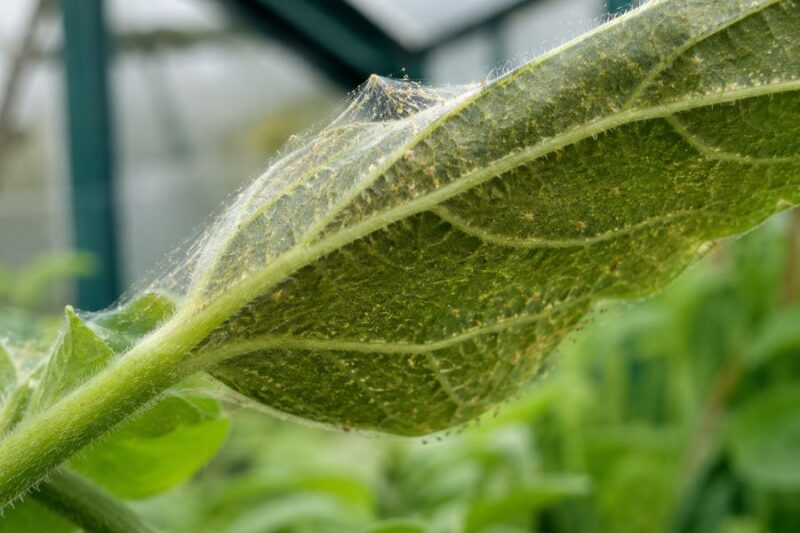
Look for fine, silky webbing on the undersides of leaves and between stems. You may also notice a yellow, stippled or mottled pattern on the upper surface of leaves, caused by the mites piercing plant cells to feed. Run your finger across the underside of a suspect leaf – if it comes away with tiny specks of dust that move, those are your mites.
What Does Spider Mite Damage Look Like?
The stippling effect is the clearest early sign. Leaves take on a dull, bronzed or silvery appearance and in severe cases they yellow completely and drop. Cucumbers, tomatoes, courgettes, roses and houseplants are among the most commonly affected. Catching the infestation at the stippling stage gives you far more treatment options than waiting until webbing covers entire shoots.
How to Get Rid of Spider Mites Organically UK Gardeners Should Know
There are three proven organic approaches and the most effective results come from using them in combination. Choosing organic methods also protects the predatory insects and mites that naturally suppress pest populations – something chemical pesticides actively destroy.
Neem Oil Spray: The Most Accessible Treatment
Organic neem oil is a highly effective natural miticide. Neem contains azadirachtin, a compound that disrupts the mites’ hormonal systems, preventing them from feeding and reproducing effectively. For spider mites, a dilution of approximately 5ml of pure neem oil per litre of water works well, with a few drops of washing-up liquid added as an emulsifier to help it mix.
Apply in the evening – this is important because neem can cause leaf scorch in direct sunlight, and evening application allows the spray to dry overnight without damaging foliage. Target the undersides of leaves thoroughly, as that is where mites concentrate. Reapply every five to seven days for at least three cycles to break the egg-to-adult lifecycle. If you prefer a ready-formulated option, neem organic fertiliser combines soil-feeding benefits with natural pest deterrence.
Biological Control: Predatory Mites for Greenhouse Growers
For those growing under glass, biological control is arguably the most reliable long-term solution. The predatory mite Phytoseiulus persimilis feeds exclusively on spider mites and reproduces faster than its prey under warm conditions. This is the active agent in the red spider mite pest controller available at The Natural Gardener.
Introduce predatory mites as soon as you spot the first signs of infestation – the earlier they go in, the more effective they are. One of the most common mistakes greenhouse growers make is waiting until the population is already out of control before reaching for biological treatments. The predators need a food source to establish, so a small existing population is actually beneficial.
The Humidity Trick: Misting and Damping Down
Spider mites hate moisture. Raising the humidity around your plants is one of the simplest deterrents available and it costs nothing. Mist your plants in the morning and, if you are growing under glass, damp down the greenhouse floor – pour water over hard surfaces to raise ambient humidity throughout the day.
This approach will not eliminate an established infestation on its own, but as a preventative measure during dry spells it significantly reduces the conditions mites need to reproduce rapidly. Combine it with neem oil application and, where appropriate, biological controls for the strongest results.

What NOT to Do: Why Chemical Sprays Make Things Worse
This is the point most advice misses. Broad-spectrum chemical insecticides do not just kill spider mites – they kill the predatory mites and beneficial insects that naturally keep populations in check. Remove those natural predators and any surviving spider mites (which develop pesticide resistance rapidly) will reproduce without competition.
Research cited by the Royal Horticultural Society consistently shows that pesticide use disrupts predator-prey dynamics in garden ecosystems, often leading to worse outbreaks after treatment than before. This is why the organic route is not simply an ethical choice – it is the strategically smarter one.
Improving your soil biology also plays a supporting role in plant resilience. Healthier plants resist pest damage more effectively. Products like biochar and mycorrhizal fungi strengthen root systems and overall plant health, making your garden less susceptible to stress-related pest explosions in the first place.
Frequently Asked Questions
Can spider mites survive UK winters?
Spider mites overwinter as dormant eggs on bark and plant debris, hatching when temperatures rise again in spring. This is why removing debris and overwintered plant material reduces early-season populations before they establish.
How quickly does neem oil work on spider mites?
Neem oil does not kill on contact in the way synthetic chemicals do. It disrupts the mites’ reproductive cycle, so expect to see a clear reduction after the second or third application, typically within two to three weeks of starting treatment.
Are spider mites harmful to humans or pets?
Two-spotted spider mites do not bite humans or pets and pose no direct health risk. Their damage is confined to plants. However, heavy infestations can produce fine webbing that triggers sensitivities in some people with allergies.
Do spider mites spread between plants?
Yes, they spread readily by crawling between plants in close proximity and, in outdoor conditions, on the wind. Isolating heavily affected plants promptly is an important first step to prevent an infestation spreading across a collection.
If you are dealing with an active outbreak right now, the combination of organic neem oil and the red spider mite biological pest controller gives you both an immediate treatment and a sustainable long-term defence. Knowing how to get rid of spider mites organically UK gardeners can rely on means building a garden that resists them year after year and that starts with choosing methods that protect the ecosystem rather than undermining it. Browse The Natural Gardener’s full range of organic pest and weed control solutions to find everything you need for a chemical-free approach this season.
< Back to all posts