

Copper gardening tools cost considerably more than their steel equivalents and are worth the difference only if you keep tools for decades and work damp, living soil. For anyone replacing a trowel every other season, the sums do not add up.
If you have spent two or three years building soil biology, feeding beds instead of digging them and keeping chemicals off the plot, the tools are probably the last unexamined thing in the shed. That is the reader we have written this for.
Most of what you will read about copper gardening tools mixes two separate arguments. One rests on metallurgy and holds up well. The other rests on biodynamic tradition and asks for a good deal of trust.
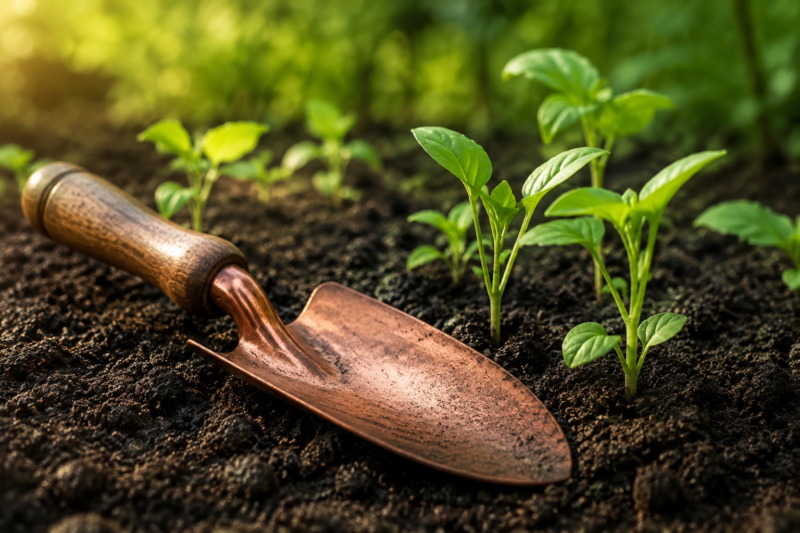
What Copper Gardening Tools Do Differently
A softer metal moves through soil differently
Copper is softer than hardened steel. In practice that means slightly less drag as the blade enters the ground, which is the quality most growers notice first and the one they tend to describe as a smoother action.
The trade off is real. A copper blade dents and deforms more readily than a hardened steel one. Lever a buried stone out with a copper trowel and you will mark it.
That distinction matters more on some plots than others. On the heavy clay common across Shropshire and the Marches, a copper trowel earns its keep in prepared beds and containers while a steel spade still does the brute work.
Copper does not rust
Rust is iron oxide, which means only metals containing iron can rust. Copper contains none. It oxidises to a patina instead, a surface layer that sits on top of the metal instead of eating into it.
Steel behaves differently. It pits, then flakes. A pitted blade drags, a rusting socket works loose and the tool fails at the joint long before the edge gives out.
In a damp shed through a Marches winter, that single property decides how long a hand tool survives. It is the strongest argument copper has.
[IMAGE: Corroded steel trowel beside a patinated copper trowel of the same age]
The Biodynamic Claim And Our Honest View
Copper has held a place in biodynamic growing since Rudolf Steiner set out the foundations of the movement in eight lectures at Koberwitz in 1924. Makers have supplied copper tools to that tradition ever since.
The claim you will meet repeatedly is that ferrous tools disturb the electrical charge of the soil while copper leaves it undisturbed. We have looked for published research establishing this and have not found any. Repeating it as settled science does copper no favours, because the material has a perfectly good case without it.
Our position is straightforward. Buy copper for the metallurgy and treat the biodynamic argument as a tradition worth respecting rather than as evidence.
One related point does hold up. Copper is one of eight essential plant micronutrients. The trace amounts a tool leaves behind therefore read as nutrition rather than contamination. Copper toxicity is a question about repeated spraying at agricultural scale, not about a dibber.
Which Copper Gardening Tools Earn Their Place
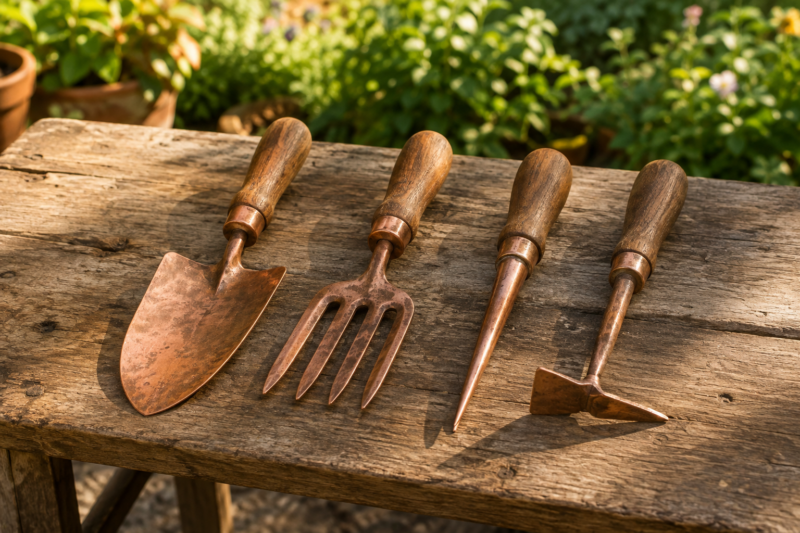
Trowel. The one to buy first. Transplanting, bulb planting, container work and raised beds account for most of what a hand tool ever does.
Hand fork. Weeding and aerating around established plants. It disturbs shallow root systems less than a steel fork of the same width, which matters in a densely planted kitchen garden or herb bed.
Dibber. Clean planting holes with minimal compaction around the seed. The simplest tool in the kit and the one where the low drag argument shows most clearly.
Hoe. Surface weeding between rows, in either long handled or stirrup form. Skimming just below the surface severs weeds without turning fresh seed up into the light, which is the habit that keeps a no dig gardening bed clean year after year.
Does The Cost Actually Work Out
Set a copper trowel you buy once against a steel trowel you replace every few seasons. It is a simple sum that turns on a figure only you know: how often you currently replace tools.
Gardeners who lose hand tools to rust in an open shed will see the saving quickly. Gardeners who clean, oil and hang their steel every autumn may never see it at all.
The wider argument matters more to us. Buying one good tool instead of five poor ones follows the same logic as sustainable gardening in the UK and the eco friendly gardening tips we return to across this site: fewer things, made better, kept longer.
Frequently Asked Questions
Do copper gardening tools deter slugs?
No. Copper tape around a pot rim is a separate question and a contested one. A copper trowel spends its working life in your hand and never forms a barrier around a plant. It does nothing for slug pressure, whereas nematodes and the routines in our guide to handling gardening pests naturally will do considerably more.
Will copper leach into the soil and harm plants?
Tool contact leaves only trace amounts. Copper is an essential micronutrient at those levels. The toxicity concern applies to repeated copper based sprays across whole fields over many seasons, which is a different scale of exposure entirely.
Do copper tools need special care?
Very little. Rinse the soil off and dry them before they go away. The patina that develops protects the metal. Leave it alone unless you prefer the shine, in which case lemon juice and salt will bring it back.
Are copper gardening tools worth it for a beginner?
Probably not as a first purchase. Build the soil first with compost, biochar and sensible companion planting. Buy the copper trowel once you know you will still be gardening in ten years, because that is the horizon over which it pays for itself.
Where To Start
One tool you use often will tell you more than a full set bought at once. Start with the trowel and add to it only when you miss something.
We choose our copper gardening tools on the same principles as everything else we stock in Knowbury: made to last, honest about what they do and free of the chemistry we spend the rest of our time helping you avoid.
< Back to all posts